
Students gain hands-on experience working in collaborative research through Student Research Fellowship program
Fifteen Ferris State University students spent their summers working in collaborative research with several faculty members, performing projects that address various scientific, technological and mathematic considerations. These individual projects, made possible by the Student Research Fellowship (SRF) program, enrich the educational experience of students and contribute to the professional development of their faculty mentors.
Read on to learn more about some of the research projects that the SRF program made possible in Summer 2017, in the students’ own words.
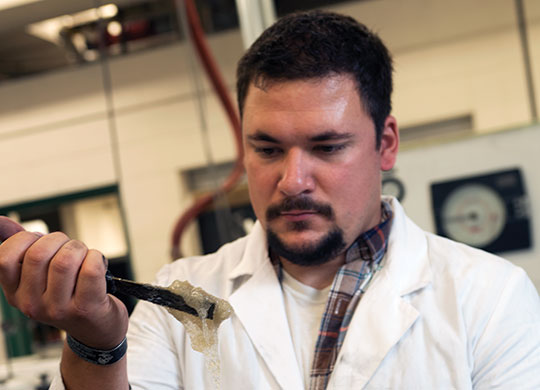
Jeffery Dickerson, Plastics Engineering Technology
Faculty Mentor: Dr. Matthew Yang, College of Engineering Technology, School of Design and Manufacturing
Impregnating Textiles with Shear Thickening Fluids
The 2017 Student Research Fellowship has been an incredible learning experience. I wanted to learn more about non-Newtonian dilatant (shear thickening) materials. Most of what we learn in the plastics and rubber programs are materials that exhibit shear thinning behavior; when enough stress is applied on the polymer, the material will flow easier which is important for processing the material. However, shear thickening materials do the opposite when a stress is forced upon the material. They harden until the stress is dissipated and then return to a more flowable, or less viscous state. This particular phenomenon has a lot of potential to be exploited in a wide array of industries and fields of work. I have been focusing on impact and penetration resistance for soft body armor.
Professor Matthew Yang has provided a substantial amount of information when considering polymer interactions in both aspects of chemistry and physics. This field is gaining rapid interest by many companies and individuals for its unique properties and untapped potential; this was a learning experience for both of us. Professor Yang could draw from his extensive history in the field of polymer science and put some explanation into what is happening. This allowed for a very unique learning opportunity, and forced me to draw upon what I’ve learned in my short time here and put concepts and ideas into action.
I was very humbled to have the support from Professor Yang and the rest of the faculty in the Plastics and Polymer Engineering programs during this research. I hope to continue studying this subject in my last year here at Ferris and carry my work into the rubber industry.
Benjamin Doyle, Applied Mathematics
Faculty Mentor: Dr. Anil Venkatesh, Arts and Sciences, Mathematics
The Luckiest Abelian Group: Examining the Error Term of Cohen-Lenstra Heuristics
Our research focused on the probability of certain class groups arising from negative quadratic extensions. We looked at a mathematical formula that estimated the probability of a number ring having a certain quality and compared that estimate to the actual probability, looking at the accuracy of the estimate as the discriminants of the rings tended towards infinity. I worked alongside two other students, Alex Eastwood and Phillip Renne, to analyze our data, with the advising of Dr. Anil Venkatesh.
Working with two other students meant that I did not get as much of the one-on-one work in with my advisor as other fellowship students did with theirs; however, it was still much more focused than any classroom experience would be. I was much more inspired to dive deeply into the subject than I would be in a classroom, and the project was incredibly useful in getting me accustomed to the work I may be doing some day in this field.
Kylee Jones, Biotechnology
Faculty Mentor: Dr. Felix Amissah, Pharmacy, Pharmaceutical Sciences
Effect of Cyclooxygenase Inhibition on the Polyunsaturated Fatty Acid Induced Apoptosis in Lung Cancer Cells
With the SRF program, I have had the privilege of working with Dr. Amissah for 10 weeks this summer and had a great time.
The SRF has been invaluable to me, as I have had an inside look at cancer research from the perspective of a professional researcher. While looking at the combined effects of Aspirin and docosahexaenoic acid (DHA) on lung cancer cells, I cultured the deadly cancer cells, conducted several experiments involving treating the cells to cause cell death, tested treated cells to see if the progression of the cancer cells could be stopped, and also tested whether the treatment could prevent cancer relapse once treatment was removed.
Over the summer, I utilized some of the equipment, technologies and processes required for the research field. Dr. Amissah encouraged me to ask questions, reason through things and progress to the next level of thinking. With my experiences of both triumph and frustration, I am more prepared for what lies ahead of me.
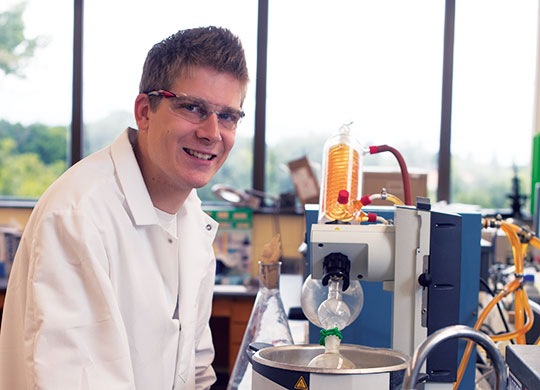
Joseph Kohane, Pharmacy
Faculty Mentor: Dr. Tracey Boncher, Pharmacy, Pharmaceutical Sciences
The Up-Scale Synthesis of Novel PPAR Gamma/Delta Analogs for Alzheimer’s Disease
This summer, Dr. Boncher and I have been working on synthesizing molecules that have activity at peroxisome proliferator-activated receptors. These gamma/delta receptors play a crucial role in Alzheimer’s disease, and it has been previously shown that these molecules have tremendous potential to not only stop the progression of the disease, but also to improve both long- and short- term memory. They do this by getting across the blood-brain barrier and causing a decrease accumulation
of b-amyloid plaques and hyper-phosphorylated tau protein, the hallmarks of Alzheimer’s disease. It has also been shown that these molecules will induce the brain-derived neurotropic factor. The molecules were originally synthesized via solid phase chemistry techniques, but the new derivatives are built via traditional solution phase reactions to ensure higher yields. All intermediates and products are analyzed with infrared and nuclear magnetic resonance spectroscopy to ensure the desired products were achieved.
Dr. Boncher has a U.S. patent on some of her molecules, and one has been tested in vivo to see any improvements on Alzheimer’s disease. Our end goal is to scale up our lead compound and then synthesize some derivatives that are expected to have greater affinity at the receptor sites.
This work is expected to yield significant results and further advancement of a series of molecules that are potentially beneficial for this terrible disease that is affecting one in nine Americans over the age of 65.
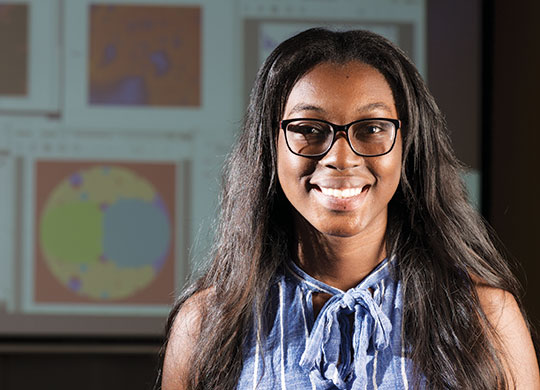
Anzhané Lance, Actuarial Science
Faculty Mentor: Dr. David M. McClendon, Arts and Sciences, Mathematics
Complex Dynamics of a Family of Quadratic Rational Maps
One of the most important things I’m learning through my research is perseverance. Sometimes, it can be really hard to study things that haven’t been studied before, and it’s very easy to get discouraged and overwhelmed. I’ve learned to persevere on the days when it’s tough and allow myself to feel proud on the days when I reach my goals. So, persistence has definitely been the hardest lesson for me to learn so far, but one of the most valuable. I’ve also gained a greater love and understanding for my craft. Math is pretty cool, and there are so many layers to it. For example, my project is in dynamical systems. I am taking a family of mathematical models and classifying them according to whether their behavior is predictable or chaotic. To do this, I use ideas from lots of different kinds of math, like algebra, geometry, topology, calculus, complex numbers and other areas. I feel as though I discover something new about math every day, and every day my attraction to the subject grows immensely.
Working with my faculty mentor, Dr. David McClendon, has also been a very rewarding experience for me. I believe my work is a lot like what I can expect in the real world; I receive a task and some background information, then I execute. I am also required to communicate what I’ve learned to other people that may not necessarily “speak” math. Effective communication is such an important part of anything that I do, so developing my ability to communicate has been very enriching and will stay with me for a long time. Also, it’s very inspiring to work with Dr. McClendon. He’s accomplished many things that I can only dream of, and his example pushes me to be better. In fact, he pushes me to excellence. I feel that, if I continue to work hard, I could be where he is, and I could accomplish any other goal that I set for myself. I believe that Dr. McClendon sees my talent and potential, and pushes me to be great, which has made me realize the greatness within myself.
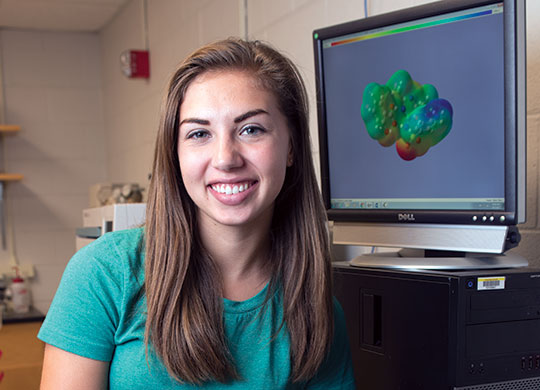
Jordan Lee, Biotechnology
Faculty Mentor: Dr. Mark Thomson, Arts and Sciences, Physical Sciences
Geometry Optimization and Energy Calculations for Hydrogen Bonded 1:1 Co-Crystals of Carboxylic Acids with Sulfisomidine and Sulfamethazine
As a Biotechnology major, working in research is my ultimate goal. Therefore, the opportunities provided by the Student Research Fellowship are invaluable for me. I have been able to pursue research, set and achieve project goals, and work with many helpful faculty and students.
The focus of my research was the differing abilities of two sulfa drugs, sulfamethazine and sulfisomidine, to co-crystallize with carboxylic acids. I used crystallographic data to perform computerized energy calculations and geometry optimizations to gain a better understanding of the
co-crystallization process. Collaboration has been a particularly important part of my SRF experience thus far. I am fortunate enough to be working on a project that is closely linked to those of two other student research fellows, Brandon Mihelich and Ian Steinke. Because we share the same main topic of co-crystallization, we typically meet once a week with our faculty mentors, Mark Thomson and Dan Adsmond, to discuss our progress.
This has been extremely helpful, because it introduces new perspectives to problems and helps us to gain a deeper understanding of the overall topic. Furthermore, each student has the opportunity to present and defend his or her research during these meetings—an integral skill in any research field. Completing my work as a student research fellow has been rewarding and enlightening, and collaborating with mentors and fellow students has greatly improved my experience.
Abbey Magolan, Pharmacy
Faculty Mentor: Dr. Felix Amissah, Pharmacy, Pharmaceutical Sciences
Effect of Cyclooxygenase Inhibition on the Polyunsaturated Fatty Acid Mediated Regression of Lung Cancer Cell Migration and Invasion
This summer I have been given the opportunity to conduct research in the College of Pharmacy with Dr. Felix Amissah. We researched the effect of cyclooxygenase inhibition on the polyunsaturated fatty acid mediated regression of lung cancer cell migration and invasion. Aspirin and DHA were used in combination, in the expectation of inhibiting migration and invasion, and we saw some promising results.
I have enjoyed the opportunity to conduct research alongside and work one-on-one with Dr. Amissah this past summer. I have learned a lot, and I am glad to have had this opportunity. He has been very helpful, and I look forward to working with him in the future.
Patients often ask me why there aren’t drugs available for certain disease states. Being able to conduct research with lung cancer cells has opened my eyes to how in-depth pharmacology research really is. Now when patients ask me, I can have a better idea as to what the research entails.
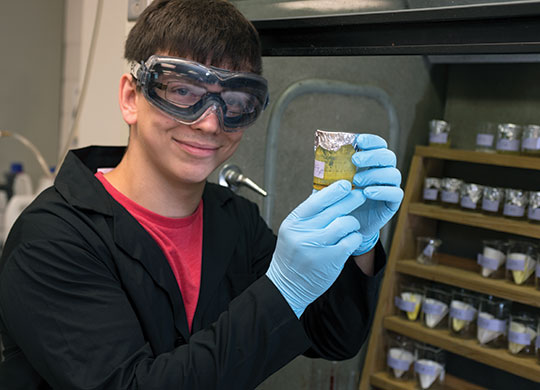
Brandon Mihelich, Chemistry
Faculty Mentor: Dr. Daniel Adsmond, Arts and Sciences, Physical Sciences
An Investigation of Ditopic Donor Monotopic Acceptor Pairs in the Design of Ternary Co-Crystals
Everyone has heard and used the word “crystal” when referring to jewelry; however, this word describes more than the glamorous materials people normally think of when hearing this word.
Crystals are specific, lattice-like arrangements of chemical “building blocks,” where usually one type of building block repeats throughout the entire structure. The structure of a crystal is highly ordered and consistent throughout, with no room for outsiders, except in cases where there’s a very small number of impurities (examples: rubies and sapphires). The high degree of specificity in these structures is dictated by a plethora of molecular forces that arrange the building blocks in a stable, low-energy arrangement. Generally speaking, the strongest of these forces are ionic attractions that often lead to predictable arrangements that form salts, like the kind we put on our food or often what medicine is administered as. Despite salts being common, other types of crystals are formed using only a combination of the weaker forces, such as hydrogen bonds.
This summer I’ve been working with Dr. Adsmond to learn more about the weaker forces that drive crystal formation and how we can predictably use these forces (specifically hydrogen bonds) to bring two or more different types of molecules together in the repeating structure of the crystal, known as co-crystallization. The goal of my research is to add to the limited list of published ternary co-crystals, which contain three different types of molecules in the repeat unit. My research this summer has given me an opportunity to work with Dr. Adsmond one-on-one to enhance my overall understanding of chemistry, as well as gain knowledge in his specific area of study. I have also had a chance to learn more about graduate school and the challenges full-time research brings, which ultimately has helped me prepare for graduate school.
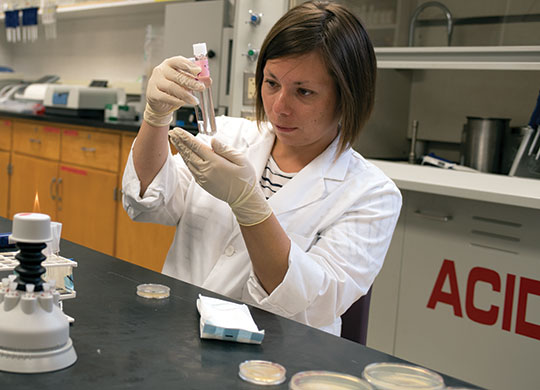
Catherine Mirto, Biotechnology
Faculty Mentor: Dr. Anne Spain, Arts and Sciences, Biological Sciences
Prevalence of Antibiotic Resistance in Bacteria Exposed to Perfluorinated Compounds versus Bacteria from Pristine Environments
My project this summer explored the microbial community from a location contaminated with a group of chemicals called “perfluorinated compounds,” or PFCs. I researched whether bacteria exposed to these compounds are more resistant to antibiotics than bacteria from uncontaminated locations. Sometimes bacteria can acquire genes to deal with a certain type of pollution and end up gaining other beneficial genes, like those for antibiotic resistance. My project explored the correlation between these two. My faculty mentor for this project was Dr. Anne Spain.
One of the best aspects of working one-on-one with a faculty mentor is having someone understand how frustrating research can be. Some days, nothing goes as expected, and experiments can be repeated over and over with no success. This was the case on the day of my big experiment; nothing worked properly. I felt exasperated, but my mentor, Dr. Spain, was calm and understanding. She explained the importance of identifying what was going wrong but not to be discouraged or to feel as if I was failing. I found this to be difficult, as I felt greatly invested in my research project. It was encouraging to have Dr. Spain’s experience and perspective during those times. There are many qualities I have gained from my research this summer, but remaining resilient and calm during stressful situations are the two most important.
Anthony Picard, Public Health
Faculty Mentor: Dr. Emmanuel Jadhav, Health Professions, Public Health
Leading from the Front: Variation between Rural and Urban Accredited Agencies
Both small and large local health departments (LHDs) are aggressively pursuing Public Health Accreditation. However little is known about individual leader and organizational capacities, or about the variations in the health outcomes of these accredited LHDs. The objectives of our study were to 1. Identify variations in leader socio-demographics and organizational characteristics between urban and rural LHDs, and 2. Examine the variation in health outcomes. For this we examined data from the 2016 National Profile of Local Health Departments. The study utilized statistical methods that I learned as part of my curriculum.
I have worked with my faculty mentor, Dr. Emmanuel Jadhav, in the past. I was recruited by Dr. Jadhav in 2015 to serve as a research assistant after I completed his biostatistics course and had shown interest in the field of public health research. Our previous study is still ongoing and will be completed later in this semester. This past spring, I learned of the SRF program taking place in the summer and was interested in continuing to work with Professor Jadhav. He has has been an outstanding mentor and has helped me develop the professional skills required for the SRF as well as my career, and he has also helped me discover my passion for field of biostatistics and public health research. Having the opportunity to work under a faculty mentor with a program such as the SRF has only increased my passion for this field.
Hunter Pope, Biology/Pre-Medicine
Faculty Mentor: Dr. M. Beth Zimmer, Arts and Sciences, Biological Sciences
Effect of Upper Cervical Spinal Cord Injury on the Hippocampus: Structure and Function
This summer, I have been working with Dr. Beth Zimmer on a research project looking into the differences in levels of brain-derived neurotrophic factor (BDNF) between spinal cord injured rats and non-injured rats. This research will be compared with tests that analyzed these rats’ learning and memory abilities, which will help determine whether or not lower levels of BDNF are related to decreased learning and memory ability.
Through all of this lab experience and the guidance of Dr. Zimmer, I have gained knowledge of common biological tests run in labs, as well as on processes carried out and materials used (e.g. making paraffin slides of tissue samples, running gel electrophoresis and western blots, etc.). I have learned more about working in a lab than I ever have from any lab section of a class.
I am very grateful to Dr. Zimmer for not only giving me this opportunity to learn, but also for helping me through the experience. She has a wealth of knowledge that she was willing to share with me as I conducted experiments and ran tests. Dr. Zimmer is teaching the neurobiology course here at Ferris in the fall, and with her expertise in the field of neuroscience, my interest in the nervous system has been consistently satisfied by her teaching. It is my goal to one day become a neurosurgeon. Thanks to Dr. Zimmer, this summer was full of information and research related to the field of neuroscience, and I am one step closer to my goal.
Danielle Rustem, Pharmacy
Faculty Mentor: Dr. Claire Saadeh, Pharmacy, Pharmacy Practice
Medical Marijuana Use in a Community Cancer Center
My Student Research Fellowship was a learning process from start to finish. This project allowed me to experience things that not every student gets a chance to be a part of while they are still in school—from submitting our original proposal to the Ferris and Sparrow Hospital Internal Review Boards, to interacting with patients on a daily basis, to preparing an article to submit for publication in a scientific journal. I cannot thank Provost Blake, the Office of Research and Sponsored Programs, or the deans of the various colleges (specifically, Dean Durst from the College of Pharmacy) enough for supporting this project, and the projects of all other students this summer.
I have always enjoyed getting to know professors outside the classroom. In my time working with Dr. Saadeh this summer, not only have I gained a mentor, but I have also had the opportunity to learn more about oncology and the pharmacist’s role in helping to treat patients with cancer. I was able to ask Dr. Saadeh numerous questions about various cancers and chemotherapies, join her while she went over oral chemotherapy agents with patients just beginning their treatments, take part in the Pain Management Supportive Care Clinic at Sparrow, and attend both a Tumor Board Meeting and an Oncology Grand Rounds Presentation. I am very grateful to have had the chance to spend the summer learning from my research experience as well as my faculty mentor.
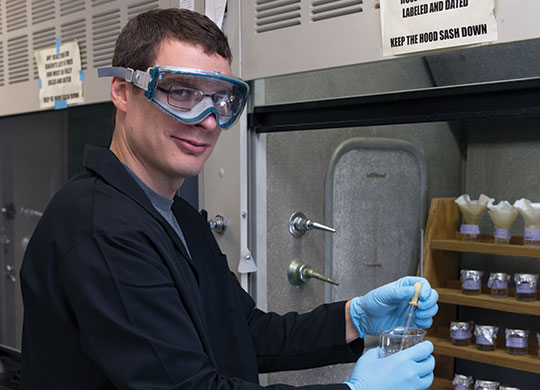
Ian Steinke, Chemistry
Faculty Mentor: Dr. Daniel Adsmond, Arts and Sciences, Physical Sciences
An Investigation of the Hydrogen Bond Connectivity between Sulfa Drugs and Nitrogen-Containing Coformers in Co-Crystals
Participating in this student research fellowship has taught me many things that cannot be gained from a book. One very important skill I acquired during this research was how to accurately write and report data, so that the data can be easily read and interpreted by others. This includes being able to express my work on every level, so that anyone, from an experienced or very limited background, can understand what I am trying to convey to them. This has led me to understand chemistry on a much deeper level than I would have had without this experience. The research has also given me a preview of the type of work being done on the graduate level, which really showed me the amount of dedication and commitment I need to have to succeed.
Having Dr. Adsmond as a mentor has helped me tremendously. I was given a great deal of insight into the different focuses of chemistry and the pursuit of graduate school, which has provided me with a much better plan for myself. Being able to hear about Dr. Adsmond’s graduate school experiences, what it was like for him and the amount of work required, has really shed light on the level of commitment required. It provided me with helpful feedback on areas in which I am weak and areas in which I am strong, which gives me the opportunity to strengthen or reinforce those areas. It meant a lot to me that a Ph.D. like Dr. Adsmond took time out of his busy schedule to help me learn, and I couldn’t be more grateful for the opportunity.
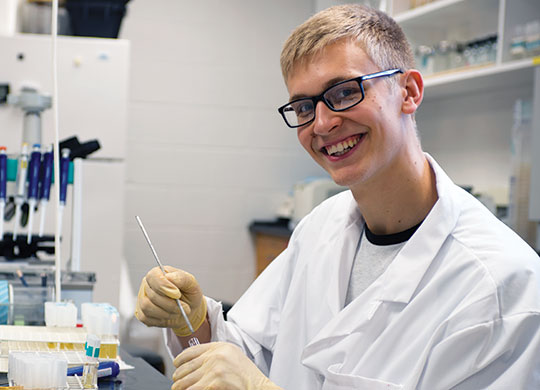
Austin Vanwyk, Biology/Pre-Medicine
Faculty Mentor: Dr. Anne Spain, Arts and Sciences, Biological Sciences
Horizontal Gene Transfer in the Presence of Antiseptics
I set out to use research as a stepping stone to further my education and better my résumé for professional school. Research did all of this, but, going into it, I didn’t fully understand just how much I was going to learn.
I built skills in problem-solving, planning and documentation, as well as in microbiology. As a researcher, you learn practical knowledge about your focus far beyond what you could hope to learn in a classroom. I specifically researched horizontal gene transfer in the presence of antiseptics. After researching this topic all summer, I have a much deeper understanding of bacterial genomics as well as the mechanisms by which many antibiotics and antiseptics work. Once I was confident in my knowledge, I then could begin experimenting. This was another huge learning point; many experiments seemed fail or go awry. However at the end, when the kinks are worked out, there’s a large collection of data to analyze and a feeling of satisfaction in yourself. Research was an exciting new way for me to learn outside of the classroom and has reinvigorated my excitement in a lot of my studies.
I also was able to get to know faculty throughout the summer. My faculty advisor, Dr. Spain, met with my lab partner, Catherine Mirto, and I regularly. We would chat about what we were hoping to accomplish moving forward with research, and Dr. Spain would give us some insight and pointers along the way. The conversation very rarely stopped with research; however, it often extended to stories of when Dr. Spain was an undergrad student or some other snippet from the past. It allowed us to talk much more than we ever could have in a classroom setting and really build a relationship that would otherwise not been possible.
This program also allowed me to meet with other faculty and staff members of the biology department. By the end of the summer, it was not out of the ordinary for me to stop in and chat with many of the Biology stock room staff. Again, not just about research, but about pieces of their personal lives outside of the classroom and work. I may have set out to use research as a stepping stone, and it definitely filled that role, but I got more out of it in both knowledge and friendships than I ever could have expected.