
The Mauve Decade
By Nate Clark
Graphic Designer/Copywriter
For the better part of history, purple dye was too expensive for most people; it was associated to royalty due to its high price. However, it became widely available in the 1890s, and, suddenly, everyone was wearing mauve, which is why the decade in focus for this edition is now considered “the Mauve Decade.” This was the decade that, despite several setbacks, Woodbridge Ferris began to build his industrial school into something great.
1893
Woodbridge Ferris, at the request of Marius Preysz, begins training in pharmacy. This encourages Mr. Ferris to establish a pharmacy department at what was then the Ferris Industrial School.
1894
The Ferris Industrial School changed location from the corner of Michigan Avenue and Maple Street (in the Big Rapids Northern National Bank Building) to the corner of Oak Street and Ives Avenue (where the Prakken Building is now).
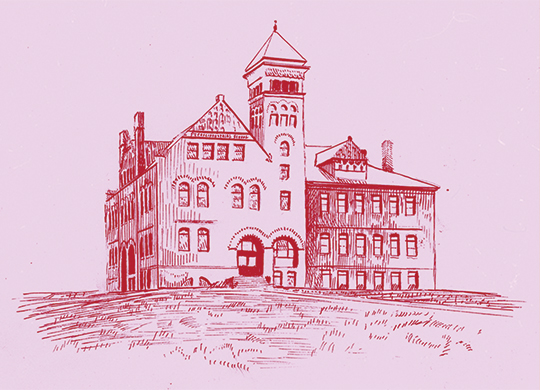
Mr. Ferris took great pains to make sure every aspect of his new building was state-of-the art and allowed for the best learning facilities for his students. He secured a contract with a Chicago firm to light the building with incandescent electric light. He boasted his building’s ventilation was nearly perfect. However, there were setbacks. The lighting proved not to be the best, and Mr. Ferris was responsible for replacing all bulbs and for the cost of fixing damages. Also, there were plumbing and ventilation issues that needed to be addressed when the building first opened, especially since it was customary at the time to have chemistry and physics labs in the basements of buildings. (There were often complaints of the smell of sulfur and sewer gas.)
1896
There was a national economic depression that took a toll on the school. At the time the faculty were notified that there was no money to pay them. All of the faculty stayed without pay. There also was a tornado, then called a cyclone. It came through Big Rapids and caused significant damage to the industrial school’s new building. Two chimneys were blown down and crashed through the roof and ceiling. Water came in and caused damage to classroom equipment. Luckily, no one was injured during this storm. The editor of the Big Rapids Pioneer started a collection and wrote an editorial to help Mr. Ferris repair the damages to the industrial school.
1898
Ferris Industrial School was renamed Ferris Institute.
Faith, Hope, Charity and Mr. Ferris
Three young women wrote a journal, illustrated with their own drawings, about life at Ferris Industrial School in the 1890s. The three titled the book, “REMINISCENCES OF FAITH, HOPE & CHARITY .”
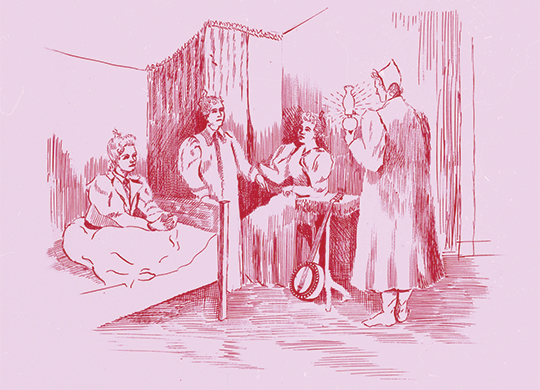
One of the three came to study because she needed to earn a living; the other two accompanied her to school as a kind of “lark.”
Early in October, their trunks were packed, and the three said goodbyes to their families. They said the people at home looked upon their plans with an air of amused wonder as to what they would do next. The people of their hometown regarded them as being on a picnic, and, as Big Rapids was a cheap place to live, they indulged them for the sake of seeing what they would do next.
Upon arriving in Big Rapids, the first thing that had to be looked into was a home. Many of the students had someone in town to look out for them, finding them housing before they got there. Faith,
Hope and Charity were not so fortunate. After searching all one Saturday in the rain, they found rooms over a store, which they decided to take until the school was moved into the new building.
According to their report, their first mishaps were on the icy city streets. It was almost impossible, they said, to go downtown with a dozen books under each arm and a pocket full of inkstands without making spectacles of themselves, especially in front of the men who stood on the corner by the bank, watching the girls go by.
During their time in Big Rapids, they moved several other times. Mrs. Ferris even tried to help them find suitable accommodations. At one point, they found themselves living in an apartment that had bugs and a wood stove that had a chimney with no draft, resulting in a room full of smoke. Eventually, they found a nice home for they remainder of their stay in Big Rapids.
As the Christmas holidays approached, the women decided to spend the holidays away from school. In those days, there were no Christmas holidays, and to get away, students had to apply for reduced rates for that week. This meant a special letter written to Mr. Ferris.
Mr. Ferris did not let their requests go unnoticed and took several occasions to mention the matter of their extravagance before the whole school. He did not mention any names, and the girls pretended the criticism did not apply to them.
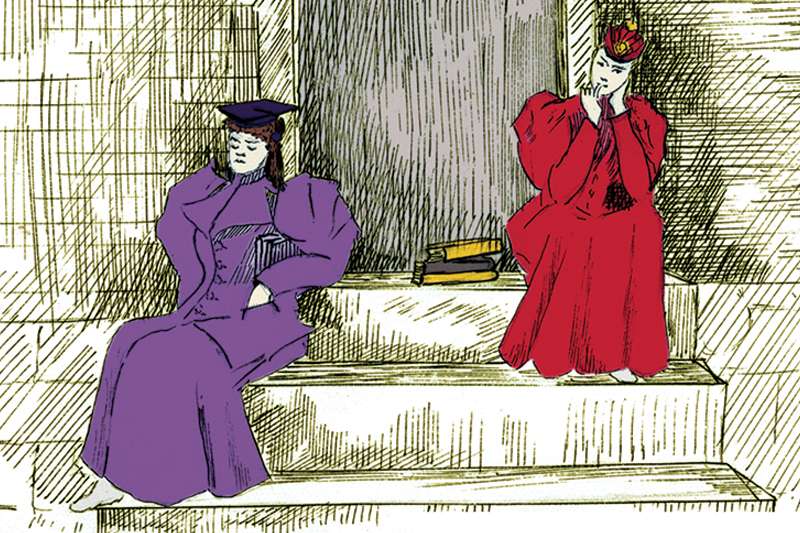
All Drawings from “Reminiscences of Faith, Hope and Charity”
It is written that students thought Woodbridge was autocratic and did not like to talk to them in their own language. However, he went out of his way on numerous occasions to help students in need. He would write letters to parents and helped secure placement for students after their time at Ferris. He personally helped care for a student who contracted typhoid fever. He had a vision for his school, and its students, “TO MAKE THE WORLD BETTER .” He did.