
New partnerships aim to put more teachers in classrooms and increase diversity in health care professions
By Jeremy Mishler
Associate Vice President for External Relations
Ferris State University recently announced two new Grand Rapids-based partnerships to help develop stronger workforces to serve the demands of the future. With the Grand Rapids Public School system, Ferris’ College of Education and Human Services has launched a teacher cadet program to help address future teacher shortages. Through the Grand Rapids African American Health Institute, the university will join a W. K. Kellogg Foundation grant-funded initiative to promote career pathways. Both efforts are intended to build diversity and retention in their respective fields by increasing engagement with prospective students.
A new academy of teaching
Throughout the 2018-2019 academic year, Ferris State University’s School of Education and Grand Rapids Public Schools have been working together to identify and prepare the next generation of
K-12 teachers to move into the workforce. The goal is to creatively address the national teaching shortage, which is already affecting school districts throughout Michigan. In 2017, GRPS experienced a shortage of 60 full-time teachers.
“Our partnership with GRPS is a major step toward building a pipeline of teachers by developing young students that are passionate about teaching,” said Arrick Jackson, dean of the College of Education and Human Services.
“It is our hope that we can capture the enthusiasm of young students of color for teaching by exposing them to the profession of teaching through field trips, lectures, and other interactive teacher preparation activities. We hope that our efforts will not only stimulate interest but sustain it over time.”
For large districts like GRPS, attracting a diverse pool of teaching talent is an issue within the larger challenge of the shortage; academic achievement gaps follow where fewer teachers share common cultural experiences with their students, and, in turn, those students also are less likely to consider teaching as a career path.
“GRPS believes that a solution to hiring diversity is to “grow our own” talent. Preparing our own students to become our future teachers means that these young people will become astute learners, as they also learn to prepare to empower youth in their own home communities. We believe it is time to cultivate our own untapped talent for the future, rather than waiting for a growth in diverse teacher pools. We also believe that connecting education and future teachers to the community they come from will enhance our efforts to recruit and retain great teachers who will drive the future student success. Ferris’ commitments to these same goals is a tremendous symbol of their shared values and vision,” said Tony Baker, Ferris’ executive director for Community Engagement and a trustee with the Grand Rapids Public Schools Board of Education.
Toward that end, COEHS developed the Teacher Cadet program, and GRPS developed its Academy of Teaching and Learning for students who participate in the program. Nineteen ninth graders enrolled in the program for
2018-19, alone.
They will have the advantage of dual enrollment classes provided through the program’s curriculum, with the opportunity to earn as many as nine college credits. Those who go on to enroll at Ferris will then receive an additional three credits toward their college degrees. After completing their college programs, these students will be placed at the top of the list for career opportunities at GRPS.
Andrea Kitomary, the College of Education and Human Services’ student retention and recruitment coordinator, said this first cohort, based at Innovation Central High School in Grand Rapids, would be the first to graduate from the program, as their 10th- through 12th-grade classes will be added annually through 2021-22.
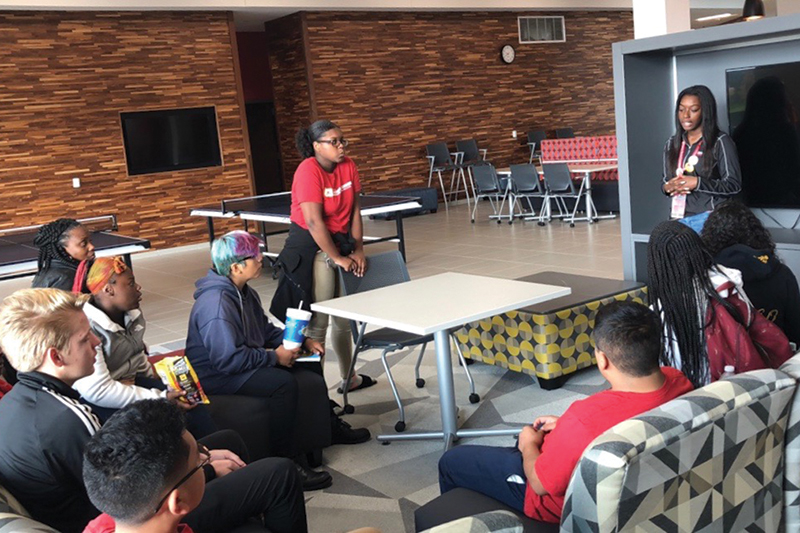
Innovation Central High School students enrolled in the Teacher Cadet Program visited Ferris’ main campus on Sept. 24.
“Having 19 students surpassed our original goal for 12 to 15 Teacher Cadet program participants in this first year,” Kitomary said. “One of our goals is to expose students to their community and Ferris State’s main campus.”
As such, the group visited Ferris’ Big Rapids campus in late September.
“Our Teacher Cadet curriculum was produced in South Carolina,” Kitomary said. “I joined two instructors this summer for a week of certified training so that we are proficient in helping these students become acclimated with what they should expect before they start their careers as teachers.”
Faculty from both Ferris and GRPS believe the experiential learning approaches provided in their instruction not only will promote awareness of the profession but hopefully inspire among students a passion for teaching and an understanding of the rewards of a career in the classroom. With the potential impact of just one student becoming a teacher who helps to positively shape the futures of thousands of others, the true value of this initiative could be countlessly measured long into the future.
“Here at Ferris State University, in the School of Education, our faculty work diligently to ensure that our teachers are prepared to enter the classrooms of today and teach students from all walks of life,” Jackson said.
“Our partnership with GRPS adds tremendous value to our efforts to prepare teachers and develop leaders to educate and inspire the 21st-Century learner.”
Building opportunity and promoting diversity in health care
Ferris also is among seven West Michigan colleges and universities supporting an effort to increase the number of students of color pursuing health care education and careers.
The Grand Rapids African American Health Institute has announced an initiative to create “Pathways to Careers in Healthcare” through a $400,000 planning grant. Awarded by the Battle Creek-based W.K. Kellogg Foundation, the grant will allow GRAAHI to engage its partner institutions to study underrepresentation of people of color in the health care fields and support development of college-specific action plans to engage diverse students and reduce barriers to careers in health care professions.
“This is by far the most influential grant we have received. It has the potential to change how medical care is delivered in Grand Rapids, and by whom,” said Shannon Wilson, executive director of GRAAHI. She cited a 2004 Institute of Medicine and Sullivan Commission study that identified a “lack of minorities in the health workforce as contributing to unequal access and quality of care.”
“We can reduce disparities in health care when our health care workforce mirrors the diversity of our community,” Wilson said.
At the initiative’s formal announcement, hosted at the Kent ISD Conference Center on June 28, Ferris President David Eisler praised the collaborative project and its goals.
“Ferris State University strongly supports the work of GRAAHI and is pleased to be a part of this W.K. Kellogg Foundation-funded project,” Eisler said. “These efforts mirror our commitment to building the opportunities a diverse workforce presents and our many efforts in educating the health care professionals of tomorrow.”
Dr. Khan Nedd, GRAAHI clinical director, spoke of the project’s overarching goals: Improving diversity in health care professions to mirror diversity in the community by 2040, establishing a cadre of West Michigan African-American and Latino health care leaders, and generating early exposure, throughout K-12, to advance health care practice careers.
Paul T. Doyle, a Ferris alumnus and GRAAHI board chair, spoke to the purpose and process of the grant and the work required to enhance diversity in West Michigan’s health professions.
“A key objective within this important initiative is to establish an intentional and inclusive framework that fosters equity within the academic context of the participating institutions,” Doyle said. “We expect to model a coordinated and sustainable pipeline approach that increases students of color entry into the health professions in West Michigan.”
Advancing our mission
Woodbridge Ferris once offered, “Schools must deal with fundamentals, must build a foundation and furnish a plan for a possible human structure of beauty, strength and service.” Opportunity and diversity have been cornerstones of the Ferris mission since its founding in 1884. Through that aim, Ferris has and will continue its work “to make the world better” by educating students from all walks of life to take on the work that supports our society.
These new partnerships will allow Ferris to build on that legacy by helping develop the more effective, more inclusive educational and health care systems upon which we will all depend in the future.
For more information about the Teacher Cadet Program, visit ferris.edu/HTMLS/news/archive/2018/september/teacher.htm or read MLive’s feature on it at http://s.mlive.com/yx0G8th.
For more information about the Grand Rapids African American Health Institute, visit www.graahi.org.
For more information about the W.K. Kellogg Foundation, visit www.wkkf.org.