
Who were some prominent Hampton-Ferris attendees?
In 2015, David Pilgrim and Franklin Hughes, of Ferris’ Diversity and Inclusion office, began a small research project to celebrate the first African-American student to attend Ferris State University. At the time, they believed this to be Gideon Smith (graduated 1912), who went on to become the first African-American varsity athlete at Michigan Agricultural College (now Michigan State University).
What Pilgrim and Hughes uncovered will change how many people understand Ferris’ history. From the 1910s to the late 1920s, dozens, maybe hundreds, of African-American students originating from Hampton Institute of Hampton, Virginia, came to Ferris Institute to study. Many of them went on to become leaders in their professional fields, such as those profiled below.
For the feature story related to this content, go to https://ferrismagazine.com/hidden-stories/.
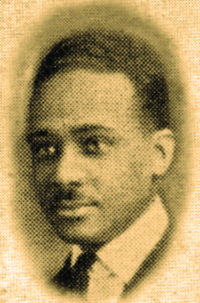
Photograph of Russell A. Dixon from Crimson and Gold (Ferris Institute Yearbook) 1921.
Russell A. Dixon
- Hampton Institute 1920
- Ferris Institute 1923
- Northwestern University 1933
Dixon is best known for his work as dean of the College of Dentistry at Howard University, where he began work in 1931. During his 37-year tenure, the college developed into one of the foremost institutions of dental education in the U.S. Dixon became the first African American to earn an advanced dentistry degree from Northwestern in 1933. At Howard, he launched the first U.S. school of dental hygiene openly available to African Americans. He appeared before a Senate subcommittee in 1945 to advocate for dental care for underserved populations. He served as president of the Pan-American Odontological Association and National Dental Association, and was appointed by Surgeon General Thomas Parran to the Medical and Health Committee of the National Defense Council and by President John F. Kennedy as regent of the National Medical Library. During his membership, the NDA challenged and overturned the American Dental Association’s policy of excluding African-American dentists. Howard named its Russell Alexander Dixon School of Dentistry for him in 1981.
Read more at https://ferris.edu/HTMLS/news/jimcrow/question/2017/January.htm.
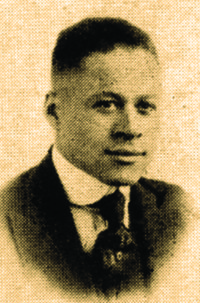
Photograph of Percy A. Fitzgerald from Crimson and Gold (Ferris Institute Yearbook) 1920.
Percy A. Fitzgerald
- Hampton Institute 1917
- Ferris Institute 1920
- Northwestern University 1924
Fitzgerald had a distinguished career as a dentist and professor, and also is known for his World War I service in the 369th Infantry, better known as the “Harlem Hellfighters.” Stationed in France, his unit saw more WWI combat time and greater casualties than any other U.S. unit, and were dubbed the “Hellfighters” because of their courage and toughness. They fought on open ground without trenches for 12 days at Meuse–Argonne in September 1918 and were the first Allied unit to reach the Rhine River. After the war, Fitzgerald took college prep at Ferris and then earned his Doctorate of Dental Surgery at Northwestern University. He practiced in Chicago until 1931, when he began a 30-year career as a faculty member at Howard University. In 1936, he became the second African American to earn a Master of Science in Dentistry at Northwestern and became head of Howard’s Prosthodontia Department. He was named National Dentist of the Year in 1959. Howard’s Percy A. Fitzgerald Outstanding Achievement Award for dental students is named for him.
Read more at https://ferris.edu/HTMLS/news/jimcrow/question/2017/february.htm.
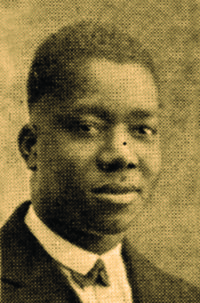
Photograph of William I. Gibson from Crimson and Gold (Ferris Institute Yearbook) 1922.
William I. Gibson
- Hampton Institute 1918
- Ferris Institute 1922
- Ohio State University 1927
Gibson is known for his work in journalism and was one of the first African Americans to receive a master’s degree from Columbia University’s prestigious School of Journalism. He began a 25-year career with the Baltimore Afro- American in 1927 as a sports writer, then as sports editor until 1934, when he became managing editor. He later became executive editor, a position he held until 1952. Gibson also was a contributor to W.E.B. Du Bois’ publication The Crisis and collaborated with Carl Murphy and William N. Jones to write an article about the history of the Baltimore Afro-American. In 1952, Gibson became the executive editor for Johnson Publishing, which published Ebony, Jet and Tan magazines. He also became a professor of English and Journalism and director of public relations at Morgan State University. In 1954, he became director of public relations for Bennett College and, in 1966, accepted a position as copy editor for the Baltimore-based News American. His wife, Ivora King, also was an accomplished journalist and one of few early women sports writers.
Read more at https://ferris.edu/HTMLS/news/jimcrow/question/2017/march.htm.
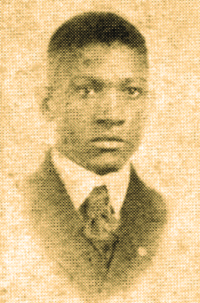
Photograph of Belford V. Lawson from Crimson and Gold (Ferris Institute Yearbook) 1920.
Belford V. Lawson
- Hampton Institute 1919
- Ferris Institute 1920
- University of Michigan 1924
- Howard University 1932
Lawson is best known as an attorney and civil rights activist. He taught at Morris Brown College and worked at Supreme Liberty Life Insurance before earning a law degree from Howard University in 1932. In 1933, he co-founded the New Negro Alliance in Washington, D.C., to combat white-owned businesses in black neighborhoods that would not hire African Americans. While working with the NNA, Lawson became the first African American to win a case before the U.S. Supreme Court; he argued and won New Negro Alliance v. Sanitary Grocery in 1938. He made at least eight appearances before the court and, in 1950, won Henderson v. United States, assisted by Thurgood Marshall. Lawson was the first African American to address the Democratic National Convention, the first African-American board member of Madison National Bank in Washington, D.C., and the first African-American national president of the YMCA. Both Lawson and his wife, Marjorie, a judge, professor and Pittsburgh Courier writer, served as advisors for John F. Kennedy’s senatorial campaign in 1958 and presidential campaign in 1960.
Read more at https://ferris.edu/HTMLS/news/jimcrow/question/2016/november.htm.
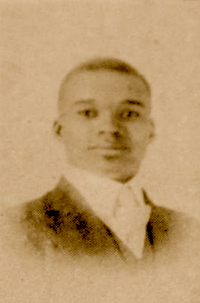
Photograph of Percival L. Prattis from Crimson and Gold (Ferris Institute Yearbook) 1917.
Percival L. Prattis
- Hampton Institute 1915
- Ferris Institute 1917
Prattis is best known for his work as a journalist. In 1921, he became city editor of the Chicago Defender, the most popular African-American newspaper in the U.S. at the time. In 1923, he became news editor of the Associated Negro Press. He interviewed or corresponded with John F. Kennedy, Haile Selassie, Eleanor Roosevelt, Malcolm X, Jackie Robinson, W.E.B Du Bois, Richard Nixon, Franklin Delano Roosevelt, Thurgood Marshall, Elijah Muhammad, Langston Hughes, Lyndon B. Johnson and Martin Luther King Jr. In 1925, Prattis founded The Light and Heebie Jeebies, the first known black news magazine. He became city editor of the Pittsburgh Courier in 1936 but also had duties as a reporter and was dispatched on international assignments. He was the first African-American news correspondent to be admitted to the press galleries of both the U. S. House of Representatives and Senate. In 1956, he became executive editor of the Courier. Pennsylvania State University’s Western Pennsylvania History Magazine produced a 13-page article chronicling his life and achievements in 2014.
Read more at https://ferris.edu/HTMLS/news/jimcrow/question/2016/october.htm.
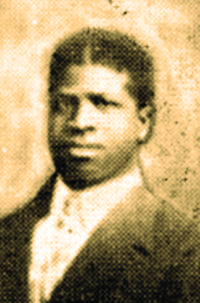
Photograph of Gideon Smith from Crimson and Gold (Ferris Institute Yearbook) 1911.
Gideon Smith
- Hampton Institute 1910
- Ferris Institute 1912
- Michigan Agricultural College 1916
Smith was the first African American to play varsity football at two different institutions and one of the first black professional football players. After his graduation from MAC (now Michigan State University) in 1916, he served as a chemical science instructor at West Virginia Collegiate Institute (now West Virginia State University). In 1919, Smith was the head football coach of the Virginia Normal and Industrial Institute (now Virginia State University). In 1921, Smith returned to Hampton Institute to become its head football coach, a position he held until 1940, compiling a 102-44-12 record, including six one-loss seasons and two undefeated seasons. His 1931 team outscored opponents 187 to 6. He was inducted into the Hampton Athletics Hall of Fame in 2009 and the Michigan State Athletics Hall of Fame in 1992. Smith was posthumously honored with the American Football Coaches Association’s 2014 Trailblazer Award, which was created to honor early coaches at historically black colleges and universities.
Read more at https://ferris.edu/HTMLS/news/jimcrow/question/2016/september.htm.